Sound but no picture on your TV? The torch test tells you in ten seconds
Darken the room. Take a torch, hold it close to the screen and at an angle, and look hard at the glass while you move the light slowly across it. If you can make out a faint picture under the beam, the shape of a menu, a row of icons, the outline of a bright scene, the panel is alive.
That is the whole test. Ten seconds, no tools, no cost, and it splits a black-screen television into two completely different jobs. Everything below is what each of the two answers means and what to do with it.
Doing the test properly
It is a simple test but it is easy to do badly and get the wrong answer, so it is worth thirty seconds of care.
- Turn the lights off and draw the curtains. The faint image you are looking for is genuinely faint. In a lit room you will miss it.
- Put something bright on the screen. Press the menu or home button on the television’s own remote. A menu is close to white, it fills a good part of the screen, and it is drawn by the set itself, which matters for reasons we come to below. Failing that, a bright scene is easier to see than a dark one.
- Hold the torch two or three inches from the glass. A phone torch is fine.
- Angle it across the screen, not straight into it. Straight on you mostly get your own reflection back. Raking the light across the surface is what brings the image up.
- Move it slowly and look for shapes, not brightness. Edges, blocks, the ghost of text. Give your eyes a few seconds to adjust before you call it.
Then change the channel or press a menu button and look again. If the faint shapes change when the picture changes, that settles it.
A faint picture means the panel is alive
This is the hopeful answer, and it is the more common one.
A modern television makes a picture in two separate stages. The panel, the glass itself, forms the image. It does not glow. Behind it sits a separate set of lights whose only job is to shine through the panel so you can see what it has drawn. That is the backlight.
If the picture is there under a torch, the panel is doing its job perfectly. Your torch is standing in for the backlight, badly and briefly, but well enough to prove the point. What has failed is the thing lighting it from behind, or the circuitry that drives it.
That matters because of what each part costs. The panel is most of what a television is worth, which is why a cracked or dead panel is so often not worth mending. The backlight is not. On a good number of sets the backlight is a repairable fault, and it is worth finding out whether yours is one of them before the set goes to the tip.
Nothing at all under the torch
If you have darkened the room, brought up the set’s own menu, raked the torch across the glass at close range and there is genuinely nothing there, the answer changes and it gets less certain rather than more.
No image means the panel is not drawing one. That is either the panel itself or one of the boards feeding it, and from the outside those look identical. This is the point where carrying on guessing starts costing money: people replace boards they found online for a set they had not diagnosed, or take the back off and make a repairable fault into a scrapped television, or write off a set that a board repair would have brought back.
Stop there and get it looked at properly. And do not take the back off yourself. There are components inside a television that hold a serious charge long after it has been unplugged, and that is a real hazard rather than a line in a manual.
Why the sound proves more than people realise
People ring up almost apologising for the sound, as though it is a detail. It is the opposite of a detail.
Sound is not a small clue. It is proof that the television powered up, booted, and decoded a picture it is failing to show you. The power supply is working. The mainboard is running. The tuner or the input is being read. The set knows what image it is meant to be displaying, or there would be nothing for the speakers to be in step with.
That rules out most of what usually kills a television. Whatever is wrong is sitting downstream of nearly everything, at the last stage, between a picture that exists and a picture you can see. That is a narrower and more hopeful place for a fault to be than a set that is stone dead or stuck blinking on standby.
Two things it is usually not
Two false trails swallow a lot of evenings.
It is usually not the box or the HDMI source. The reason the menu test above matters is that the television’s own menu is generated inside the set. Nothing carries it in over a cable. So if the menu is invisible along with everything else, no box, stick, console or cable can be the cause. If the menu comes up fine and only the box’s picture is missing, the television is healthy and you are looking at the source, the cable or the input instead.
It is not the broadband. A dropped internet connection stops apps loading and makes streaming stutter or fail with a message on screen. It does not take the picture away and leave the sound running, and it has no effect at all on the aerial, a Blu-ray player or anything plugged into an HDMI socket. If the set is also slow, signing you out of apps or buffering, that is a separate matter and usually the network side of things, not the reason the screen is black.
What is actually behind the screen
These are our own photographs of televisions with the back off. They are here to show you what the inside of a set looks like, nothing more.
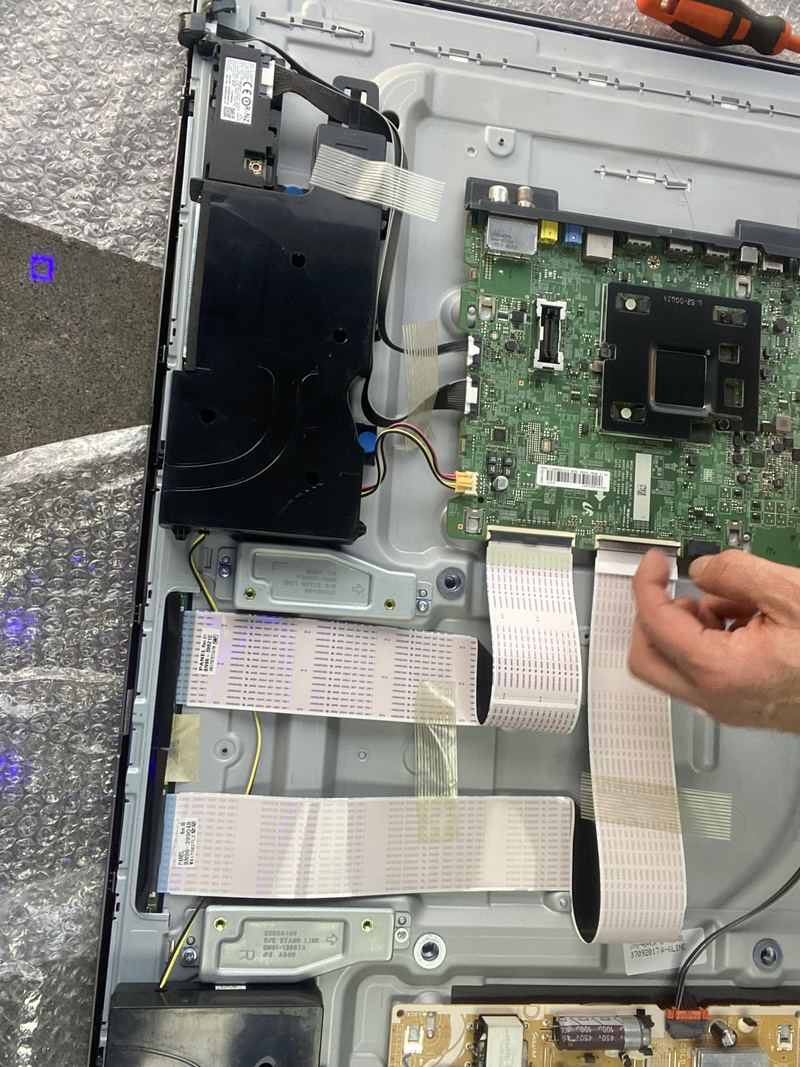
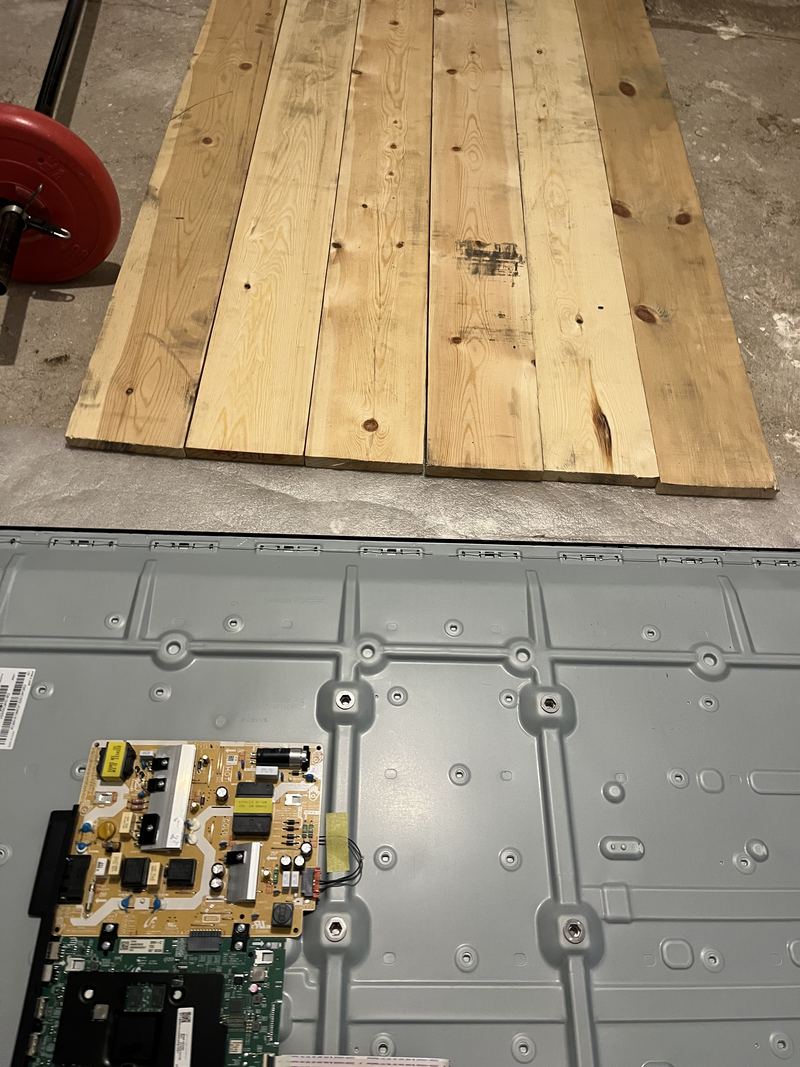
The thing worth taking from those pictures is how much of a television is empty metal and how little of it is the expensive part. The boards in the corner are a fraction of the set. The panel is the rest of it. That is the whole economics of television repair in one photograph, and it is why the torch test is worth ten seconds of your time before anybody quotes you for anything.
Why this is a come-to-you job
Nobody moves a 55-inch television across Leeds to find out what is wrong with it.
That is not a slogan, it is the practical reason TV work is done at your address rather than at a counter. A large set is awkward, it is heavy in a way that catches people out, and it is very easy to crack a panel getting it into a car, which turns a repairable fault into a scrapped television on the way to being diagnosed. There is also nothing to be learned from the journey. The set behaves exactly the same in your living room as it would anywhere else, and in your living room you still have the remote, the box, the aerial lead and the wall socket that all form part of the picture.
So we come out, look at the set where it stands, and tell you which of the two answers above you actually have.
What happens next
Do the torch test first, because it costs nothing and it changes the conversation. Then send us an enquiry while the set is still in front of you, and tell us the make, roughly how old it is, whether there is sound, and what you saw or did not see under the torch. Those four things tell us most of what we need before anyone sets off.
If you want the fuller version of the symptom, sound but no picture on a television covers where it sits alongside the other black-screen faults, and the TV and smart TV page covers the rest.
After that it is the same as every other job here. Advice by message is free. You get one fixed quote before any work starts, so there is nothing to find out at the end. And no fix, no fee means if we cannot bring the set back, you do not pay for the attempt. If the honest answer turns out to be that the panel has gone and the set is not worth repairing, you will hear that at the diagnosis, rather than after a bill.
Questions people ask
What exactly am I looking for under the torch?
Shapes, not brightness. You are not trying to light the room up through the glass, you are looking for the ghost of a menu, a row of icons, the outline of a bright scene, something with edges to it that moves when the picture moves. It is faint, and it is easiest to miss if you shine the torch straight on rather than across the screen at an angle. Turn the lights off first and give your eyes a few seconds to settle before you decide there is nothing there.
Does a phone torch work, or do I need a proper one?
A phone torch is fine and is what most people have to hand. Hold it two or three inches from the glass, angle it across the screen rather than pointing it straight in, and move it slowly. The only real advantage of a proper torch is a tighter beam, which makes the faint image slightly easier to pick out. Neither will damage the screen at that distance.
There is nothing at all under the torch. Is the television finished?
Not necessarily, but the answer stops being one you can reach from the sofa. No image under the torch points at the panel itself or at a board inside the set, and those are very different outcomes: board work is often repairable, while a failed or cracked panel is most of what a television costs and is very rarely worth mending. Which one you have needs someone to open it and measure. Start with the free advice by message, and you will know what that visit costs before anyone travels.
Is a backlight repair worth doing?
Often, but it depends on the set rather than on the symptom, so we will not pretend otherwise before looking. What it turns on is whether the right part for your exact make and model can still be had, how the set is built and how safely it opens, and what the television is worth to you. We find that out and then give you one fixed quote, and if the honest answer is that your money is better kept, you will hear that instead.
Could it be my Sky box or Fire Stick rather than the TV?
That is worth ruling out and it takes a moment. Press the menu or home button on the television's own remote, not the box's, so the set has to draw something itself. If the menu is invisible too, the fault is in the television, because a menu never travels down an HDMI cable. If the menu appears perfectly and only the box's picture is black, the television is fine and the problem is the box, the cable or the input.
Do I need to unplug anything or take the back off to check?
No, and please do not take the back off. The torch test is done with the set powered on and everything as it is. There are components inside a television that hold a charge well after it has been unplugged, which is a genuine risk rather than a disclaimer, and the back panel is also where most accidental damage to a set happens. Do the ten-second test, then stop.
Free advice by message
Not sure what your machine needs? Ask.
Tell us the fault and we will tell you straight: what is wrong, what it will cost, and whether it is worth doing. A fixed quote before any work, and no fix, no fee on the repair.
We do this in person across Leeds and West Yorkshire, day or night, Sunday to Friday.