TV has sound but no picture
The programme is playing. You can hear the dialogue, the adverts, the menu beeping as you press buttons. The screen stays black. It is a strange fault to live with, because everything tells you the television is working except the one part you actually use. The sound is not a small detail, either: it is proof that the set powered up, booted and decoded a picture it is failing to show you, which puts the fault at the very last stage rather than deep inside the machine. That is a narrower and more hopeful place for a fault to be than a set that is stone dead. There is also a ten-second test you can do yourself that splits this into two completely different jobs, and we give it away below. If it turns out to be the repairable kind, advice by message is free, you get one fixed price before any work, and if we cannot fix it you do not pay for the repair.
- No fix, no fee on the repairIf we cannot fix it, you do not pay for the repair. In writing, on every job.
- Free advice by messageDescribe the fault and we will tell you what it sounds like and whether it is worth doing, before anyone travels.
- We come to youAcross Leeds, West Yorkshire and North Yorkshire, or we collect and return.
- A real person repliesNot a call centre, not a ticket queue: we read every enquiry, day and night, Sunday to Friday. The fixed quote you agree is the price you pay.
The short version
- Sound proves the set powered up and decoded a picture.
- A ten-second torch test splits this into two different jobs.
- A faint image under the torch means the panel is alive.
- A cracked panel is most of what a television costs.
- Never take the back off. Components hold charge when unplugged.
Try this first
The torch test, in full, before anyone comes out
It takes ten seconds, it needs nothing but a phone torch, and it splits a black screen into two completely different jobs. Do it with the set switched on and everything exactly as it is.
- Turn the lights off and draw the curtains. What you are looking for is genuinely faint. In a lit room you will miss it and come away with the wrong answer, which is worse than not having tested at all.
- Press the menu or home button on the television's own remote. A menu is bright, fills a good part of the screen, and is drawn inside the set, so nothing carries it in over a cable. If the menu appears perfectly and only your box's picture is black, the television is fine and the fault is the box, the cable or the input.
- Hold a torch two or three inches from the glass and rake it across the screen at an angle. Straight on you mostly get your own reflection back. Raking the light across the surface is what brings a faint image up. A phone torch is fine, and neither will harm the screen at that distance.
- Look for shapes rather than brightness, then change channel and look again. Edges, blocks, the ghost of text. If the faint shapes change when the picture changes, the panel is alive and the fault is behind it, which on many sets is the repairable kind. Nothing at all under the torch points at the panel or a board instead.
- Leave the back on. Components inside a television hold a serious charge long after it has been unplugged, and that is a real hazard rather than a line in a manual. The back panel is also where most accidental damage to a set happens, so taking it off can turn a repairable fault into a scrapped television.
What it usually means
Why a television plays sound but shows no picture
- The backlight has failed: the picture is being drawn correctly, with nothing lighting it from behind. The commonest cause, and often repairable
- A power fault on the board that feeds the backlight, while the rest of the set carries on running normally
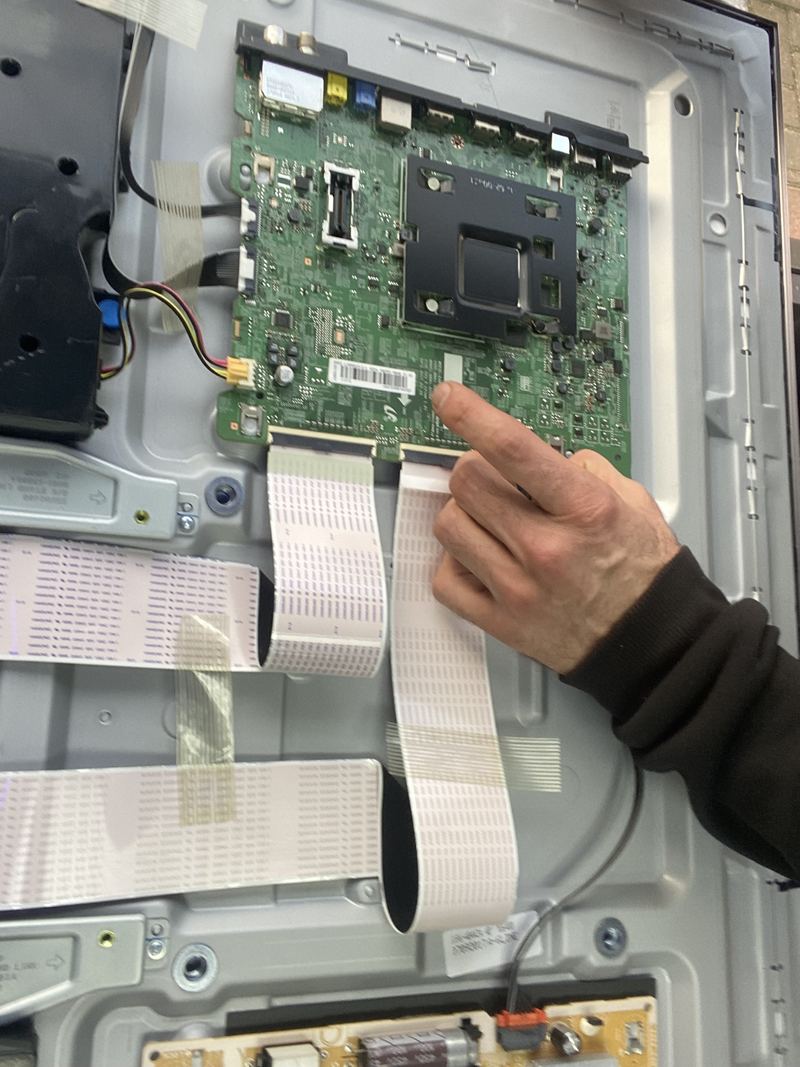
- A ribbon cable into the panel has worked loose or torn, so the set sends a picture the panel never receives
- The panel itself has failed. It is the answer nobody wants, because the panel is most of what a television costs
- The source rather than the set: a box, a stick or a cable. Ten seconds with the set's own menu rules it out
Not sure which is yours? Describe it in a message and we will tell you, free. Tell us what it is doing and we will work it out.
At a glance
What the screen is telling you, and what each answer means
The same black screen has five quite different explanations, and which one you have is something you can see and we cannot until we arrive. Find the row that matches yours.
| What you see | What it usually is | Worth repairing? |
|---|---|---|
| A faint picture under a torch | The backlight, or the board that drives it | Often the repairable kind. The expensive part, the panel, is fine |
| Nothing at all under a torch | The panel itself, or a board feeding it | Needs opening to tell those apart. Board work often, a failed panel rarely |
| A crack, blotch or line you can see | The panel, physically damaged | Almost never. The panel is most of what the set is worth |
| No sound either, standby light blinking | The power side, frequently the power board | Often a repairable part, and worth finding out before it goes |
| The set's own menu looks perfect | Not the television at all: the box, the cable or the input | Not a repair. Try another cable and another input first |
The first two rows are the ones the torch test separates, and it separates them before anyone has charged you anything. If you are in the last row, the television is healthy and you can stop reading.
What we do
How we tell a failed backlight from a failed panel
- You tell us in your message what you see and hear, and whether the television's own menu appears when you press menu on its remote
- We ask you to run the torch test before we set off, so we both already know whether the panel is alive
- We come to you across Leeds and Yorkshire, because a television is the one thing nobody can reasonably carry to a repair shop
- We open the set properly and test the backlight, the boards that feed it, and the ribbon connections into the panel
- You get one fixed price before any work. If a cracked or failed panel makes it uneconomic, we say so plainly
Is it worth fixing?
Is a TV with sound but no picture worth repairing?
Often, yes, and the torch test tells you which conversation you are having before anyone charges you anything. If a faint image appears under the torch, the panel is alive and the fault is the lighting or the boards behind it, which on a good number of sets is a sensible repair. What decides it from there is your exact make and model, whether the right part can still be had, and how the set is built and how safely it opens, so we will not pretend to know before looking. If nothing appears at all, it is more likely the panel, and a panel is most of what a television is worth, so replacing the set is usually the better answer. A panel you can see is cracked is the one case we will not even weigh up: that is a flat no, and we would rather lose the job than take it. We find all of this out and then give you one fixed quote.
This is a tv & smart tv help job. Advice by message is free, then you get one fixed quote before any work starts. If we cannot fix it, there is nothing to pay for the repair.
Send an enquiry and describe the faultWhere we work
We come to you across Leeds, West Yorkshire and North Yorkshire
Home or work, day or night, Sunday to Friday. There is no walk-in shop, so we come to the machine, or collect it and bring it back. Start at computer repair in Leeds, or pick your area.
Questions
TV black screen questions we get asked
How do I do the torch test?
Darken the room and draw the curtains, because what you are looking for is genuinely faint. Press the menu button on the television's own remote so the set has to draw something bright. Hold a torch, a phone torch is fine, two or three inches from the glass and rake the light across the screen at an angle rather than shining it straight in. Move it slowly and look for shapes rather than brightness. If you can make out the ghost of a menu or an outline, the panel is alive.
There is nothing at all under the torch. Is the television finished?
Not necessarily, but the answer stops being one you can reach from the sofa. No image means the panel is not drawing one, and that is either the panel itself or one of the boards feeding it. From the outside those look identical, and they are very different outcomes: board work is often repairable, while a failed panel is most of what a television costs and is very rarely worth mending. This is the point where guessing further starts costing money, because people buy boards for a set that was never diagnosed. It needs someone to open it and measure. Start with the free advice by message, and you will know what that visit costs before anyone travels.
Could it be my Sky box or Fire Stick rather than the television?
Worth ruling out, and it takes a moment. Press the menu or home button on the television's own remote, not the box's, so the set has to draw something itself. If the menu is invisible too, the fault is in the television, because a menu never travels down an HDMI cable. If the menu appears perfectly and only the box's picture is black, the television is fine and the problem is the box, the cable or the input.
Should I take the back off and have a look?
No, please do not. There are components inside a television that hold a charge well after it has been unplugged, which is a genuine risk rather than a disclaimer, and the back panel is also where most accidental damage to a set happens. It is very easy to turn a repairable fault into a scrapped television that way. Do the ten-second torch test with everything as it is, then stop.
Is it worth repairing, or should I just buy a new one?
It depends on what the torch test showed and on the set itself, so we will not pretend to know before looking. What decides it is whether the right part for your exact make and model can still be had, how the set is built and how safely it opens, and what the television is worth to you. We find that out and then give you one fixed quote, and if the honest answer is that your money is better kept, you will hear that instead.
Do you come out to televisions, or do I have to bring it in?
We come to you. A television is the one device a customer genuinely cannot carry to a shop, which is a large part of why we work this way. A large set is heavy in a way that catches people out, and it is very easy to crack a panel getting it into a car, which turns a repairable fault into a scrapped television on the way to being diagnosed. We open it where it stands, on your own floor, and you can watch the whole thing if you want to.
Other problems
Sound more like one of these?
Tell us what is wrong.
Send an enquiry and describe the fault. We will find the fault properly, give you a fixed quote before any work, and if we cannot fix it there is nothing to pay for the repair. A real person who does the work, not a call centre.